

Editing Copy for British English: Common US-to-UK Spelling and Punctuation Traps
You file a piece at 5pm. By half past, a sub-editor has changed "analyse" to "analyze", flipped single quotes into double, and rewritten "12 March" as "March 12". None of those choices is wrong in another country. All of them are wrong here.
British English is not American English with a few extra vowels bolted on. It has its own spelling conventions, its own punctuation habits and its own way of writing a date. Most of the trouble comes from two sources: software that defaults to US English, and a lifetime of reading American books, scripts and websites. Here is how to catch the differences before they reach a reader.
Start with a dictionary, not a hunch
Pick one authority and stay loyal to it. Oxford, Collins and Chambers will disagree with each other on a handful of points, and that is fine — what matters is that your publication is consistent. A reader notices when "organise" appears in paragraph two and "organize" in paragraph nine, even if they cannot say why it jars.
Keep a house style sheet. Every decision you make — whether you write "per cent" or "percent", whether you use the Oxford comma, how you set abbreviations — goes on it. Ten minutes of maintenance now saves an hour of argument later.
The -ise and -ize question
Default to -ise: organise, recognise, criticise, apologise, realise, minimise. This is the standard in British news publishing and the safest choice for a general UK readership. Oxford dictionaries do permit -ize, and some academic presses use it, but many British readers now read -ize as an Americanism. If your style sheet is silent, write -ise.
Two things to watch. First, analyse is not "analize" — the -yse ending is fixed in British English, along with paralyse and catalyse. Second, a group of words never takes -ise at all, whatever the accent: capsize, seize, size, prize, franchise, exercise, advertise, compromise. These come from different roots, and no amount of national pride will change them.
-our, -re and the other spelling splits
British English keeps the -our in colour, favour, honour, behaviour, labour, neighbour and rumour — but drops it in glamour, and in the -ous forms: humorous, vigorous, glamorous. It keeps -re in centre, theatre, litre, metre and fibre. Note the trap: a metre is a unit of length, while a meter measures something, as in parking meter or gas meter.
Beyond those two families, a handful of words cause most of the damage:
- Doubled consonants: travelled, cancelled, labelled, modelling, counselling — but "focused" and "focusing" are now standard in both varieties.
- Noun and verb pairs: practice (noun) and practise (verb); licence (noun) and license (verb); advice and advise; defence and defend.
- Everyday vocabulary: grey, plough, draught, kerb, tyre, cheque, storey, catalogue, dialogue, aluminium, maths, autumn.
- Words to avoid unless quoting: gotten, airplane, sidewalk, trash, sophomore, "write me" instead of "write to me".
Punctuation: quotes, commas and dashes
British publishing generally opens with single quotation marks and nests double quotes inside: 'He told me, "Don't wait," and left.' Punctuation sits outside the closing quote unless it belongs to the quoted words themselves. American style does the opposite on both counts, which is why so many drafts look subtly foreign.
The Oxford — or serial — comma is optional here. Use it where it prevents confusion, as in "the editor thanked her parents, the publisher and the lawyer", and leave it out otherwise. Never let a comma change your meaning by accident.
For parenthetical breaks, British style prefers a spaced en dash – like this – rather than an unspaced em dash. Use a hyphen only for compound words such as "well-known" or "two-year plan". Abbreviations lose their full stops: Mr, Dr, BBC, US, UK. Write "for example" rather than e.g. in running copy; it reads better and cannot be mispunctuated.
Dates, times and figures
Write dates in ascending order: 12 March 2024, with no comma before the year and no "th". Numeric dates are a genuine hazard — 03/12/2024 means 3 December in Britain and 12 March in the United States. If you must use figures, spell out the month or avoid the format entirely.
Times take a full point, not a colon: 9.30am, 5pm, 11.45pm. The 24-hour clock belongs in news reports and timetables. Decades lose their apostrophe: the 1990s, the nineties. Currency symbols go before the figure with no space: £40, £3 million, €250. Spell out numbers one to nine and use figures from 10 upwards, unless a sentence opens with one. "Per cent" is two words in running text; the symbol belongs in headlines and tables.
Words that slip past spellcheck
Spellcheck catches "colour" written as "color". It sails straight past words that exist in both varieties with different meanings. Check these by eye every time: principal and principle; dependent and dependant; stationary and stationery; complement and compliment; inquiry and enquiry; disc and disk; programme and program (a computer program keeps the short form); storey and story.
Build a style sheet you can reuse
None of this has to live in your head. Copy the decisions above into a one-page document, add the names and titles you handle most often, and keep it open while you edit.
Quotes: single first. Dates: 12 March 2024. Spelling: -ise, -our, -re. Numbers: one to nine. Per cent: two words. Dashes: spaced en dash.
Run a search for the usual suspects before you publish: -ize, color, center, practise as a noun, March 12, and any double quotation mark in dialogue. Ten searches take two minutes and catch most of what a rushed draft leaves behind. The goal is not pedantry. It is that a British reader finishes the piece without stumbling — and never once suspects the writer was somewhere else.
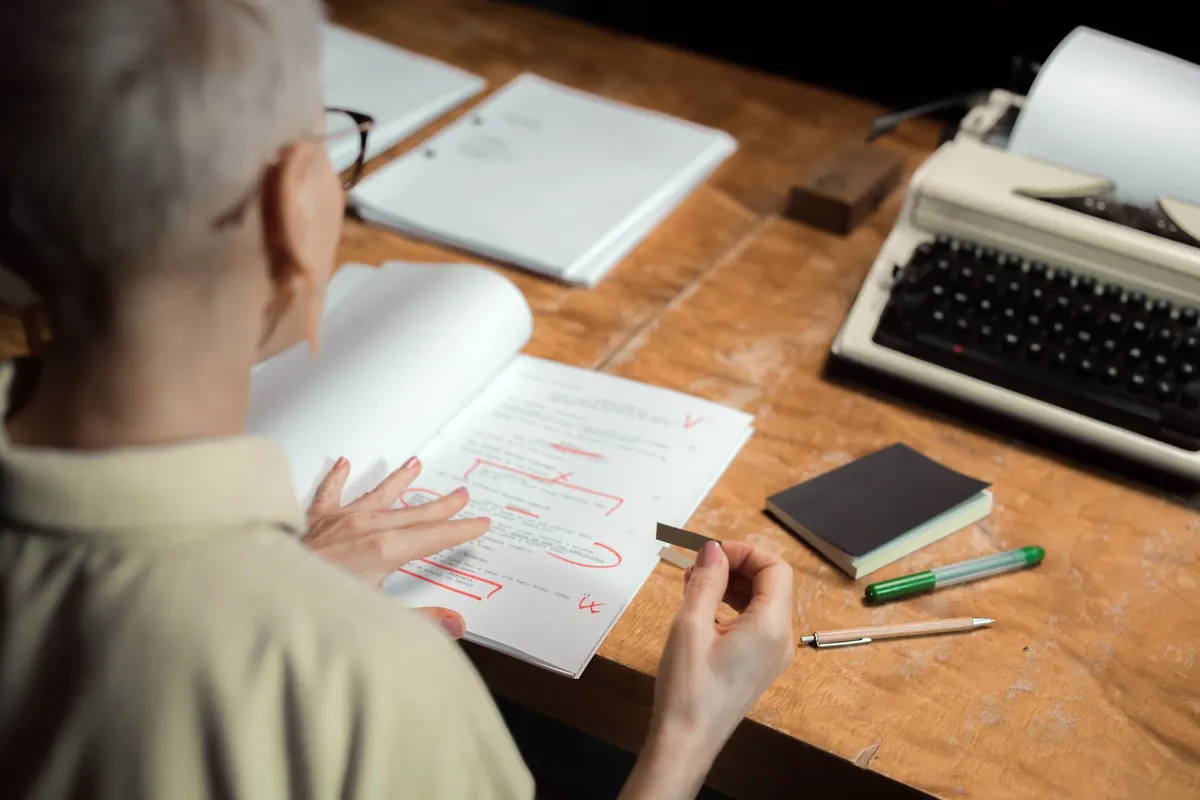
Photo: Ron Lach / Pexels